
By
Odysseas Mouselimis
UNTIL well into the 1980s, Katendrecht was Rotterdam’s sailors’ quarter, a peninsula of bars and boarding houses wedged between the warehouses of the port. When the city set out to bring residents back, its own campaign asked newcomers a blunt question: can you handle the Cape? Enough of them could. The warehouses became homes and a museum, a dance house will follow, and the peninsula now ranks among the city’s safest and most sought-after neighbourhoods. The pattern repeats across Europe: wherever a port moves out, the city moves in, and the old harbour becomes its most coveted address.
Hamburg, Rotterdam, Lisbon and Copenhagen are precedents of industrial districts that become the most coveted neighbourhoods in their cities. Distinctive architecture, cultural hubs and thoughtfully designed public spaces strengthen their appeal, creating the potential for sustained growth in property values as the neighbourhood matures.
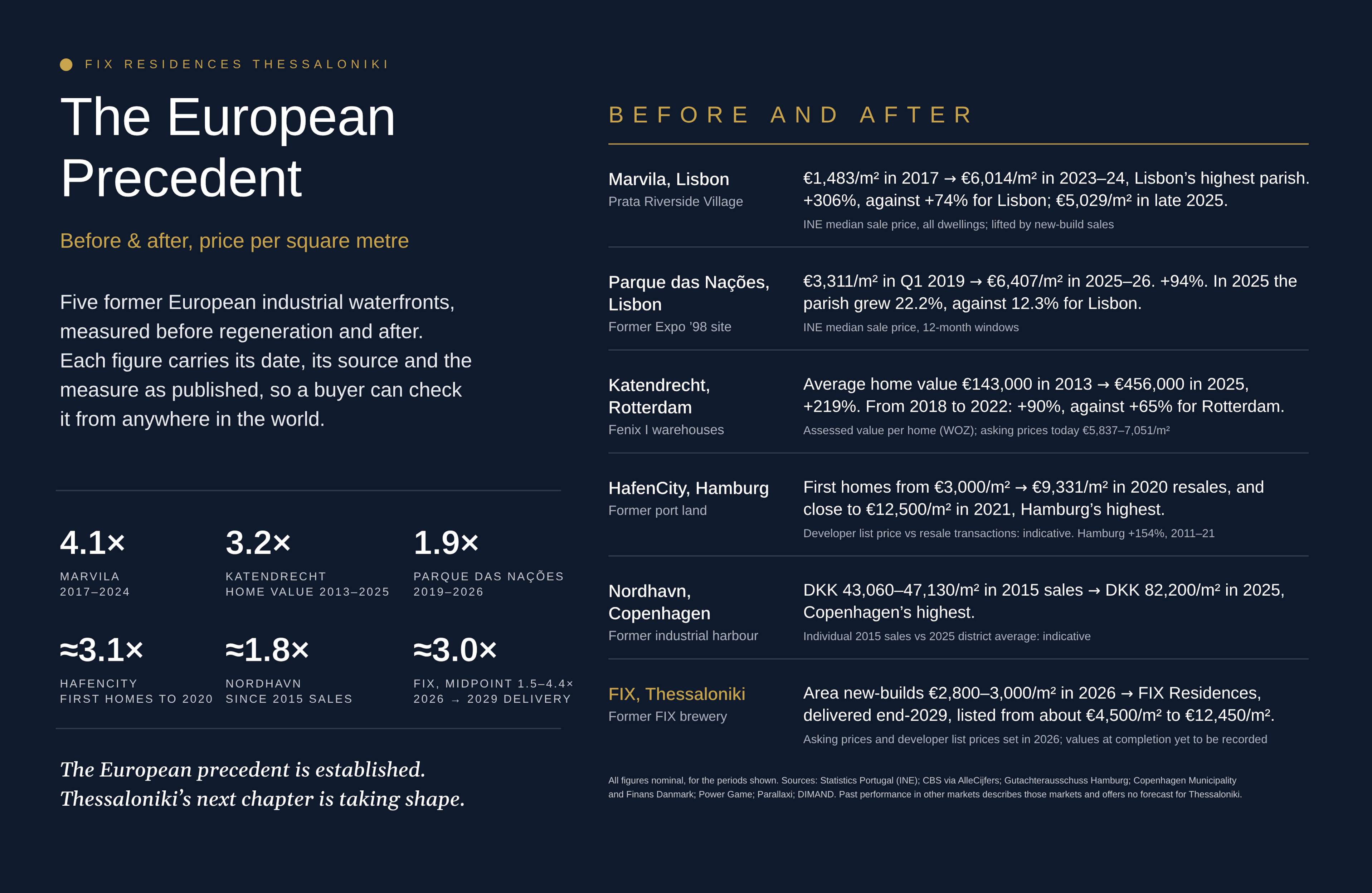
For early buyers, the opportunity lies in becoming part of that transformation from its outset. In all of these districts, early buyers saw local values rise by between 1.9 and 4.1 times as the surrounding neighbourhood matured. The figures that follow trace that path, district by district.
Hamburg built a new center on its former port and with it, a new benchmark for value.
In 1997, Hamburg unveiled plans to transform 157 hectares of former port land into HafenCity, expanding its city centre by some 40%. Plot sales by the city’s development company funded most of the €3 billion in public infrastructure, which attracted around €10 billion of private investment. The U4 metro arrived in 2012. The Elbphilharmonie followed in 2017 and has since become the emblem of the city. By 2021, more than 6,500 residents had made the district their home. On completion, HafenCity will house 15,000 residents and 45,000 jobs.
Value followed vision. In 2026, apartments in HafenCity trade at approximately €8,500 to €10,500 per square metre, against a Hamburg median of about €5,800. Rents of €18–23 per square metre rank among the city’s highest.
“Hamburg’s former port land now commands a premium of roughly 50–80% over the city median.”
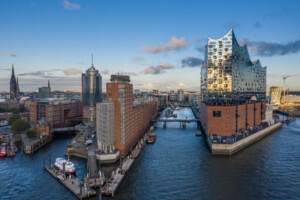
HafenCity and the Elbphilharmonie, Hamburg. Image credits: Canetti / Shutterstock.com
Lisbon’s Marvila rose from the city’s most affordable parishes to its most exclusive
On the banks of the Tagus, Marvila was long defined by warehouses, depots and social housing. Renzo Piano reimagined it as a neighbourhood. Prata Riverside Village, turned a former industrial part of Marvila into a new riverside quarter beside the Parque Ribeirinho Oriente. The complex now spans 833 apartments, with homeowners from more than 40 countries, as well as retail, services and venues for exhibitions and performances.
The official record is striking. In 2017, Marvila’s median sale price stood at €1,483 per square metre, according to Statistics Portugal. By October 2023 to September 2024, it had reached €6,014, the highest of Lisbon’s 24 parishes and well above the city’s €4,252. That is a fourfold rise in seven years. New homes led the way, making up about 70% of the parish’s sales in the twelve months to the end of 2022. Values have since moderated, with Statistics Portugal data placing Marvila at €5,029 per square metre in late 2025, more than three times its 2017 level.
“In just seven years, Lisbon’s most affordable parish rose to the top of its market.”
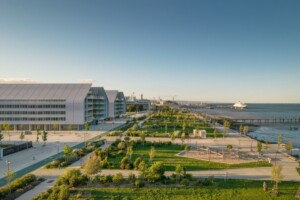
Prata Riverside Village, Lisbon. Image credits: pratariversidevillage.com
Katendrecht, a peninsula of former port warehouses on the Maas, offers the closest parallel to Thessaloniki’s FIX: heritage industrial buildings converted into homes beside a major cultural institution. Heijmans transformed the Fenix I warehouse into a residential and cultural building through adaptive reuse, a €48 million investment that preserved the character of Rotterdam’s harbour heritage. Its neighbour, Fenix II, now houses the FENIX Museum of Migration. Next door, the former Provimi warehouse is becoming the Danshuis, designed by MAD Architects and set to open in 2030 as the largest dance venue in the Netherlands.
The transformation was reflected in value. Average assessed home values in Katendrecht rose from €143,000 in 2013 to €456,000 in 2025, an increase of 219 per cent, more than tripling in twelve years. The pace outran the city. Between 2018 and 2022 alone, Katendrecht’s average value climbed from €192,000 to €364,000, close to doubling in four years, while Rotterdam’s rose from €166,000 to €275,000.
“Between 2018 and 2022, Katendrecht’s values rose 90%, outpacing Rotterdam’s 66%.”
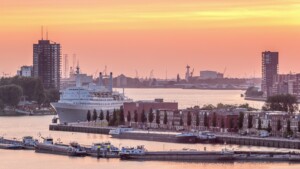
Katendrecht, Rotterdam. Image credits: Kirill Neiezhmakov / Shutterstock.com
Copenhagen’s Nordhavn turned a former industrial harbour into a city of thriving islands.
In Copenhagen, the city’s port company, By & Havn, transformed the industrial harbour of Nordhavn into a district for 40,000 residents and 40,000 jobs. Sales of the public land fund the metro that serves it. The M4 line arrived in 2020, and a former grain silo, reborn as The Silo, became the district’s signature residential address.
Here too, value followed vision. Postcode 2150 Nordhavn now ranks among the most expensive in Denmark, with 2026 asking prices of DKK 80,000 to 110,000 per square metre, against a city average near DKK 75,000.
“From grain silo to one of Denmark’s most expensive postcodes.”
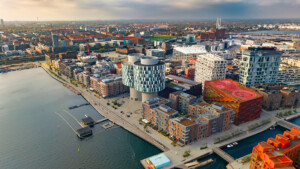
Nordhavn, København. Image credits: 7 Wonders Future Cities
Lisbon’s Parque das Nações turned the Expo ‘98 site into a prime address
Lisbon built the 1998 World Exposition on a riverside of refineries and depots, then handed the site back to the city, where it later became a parish of its own. Within a generation, a former industrial edge became one of the capital’s most sought-after addresses.
The rising trend continues today. In late 2025, Statistics Portugal ranked Parque das Nações the second most expensive parish in Lisbon, at €5,840 per square metre, with prices up 17.4 percent in a year, against a city average of €4,525.
“Once an industrial frontier now Lisbon’s most coveted address with property values on an upward trajectory”
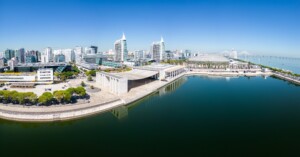
Parque das Nações. Image credits: Amantes des Viagen
Next Port of Call: Thessaloniki’s Western Gateway
For more than a century, the FIX brewery defined Thessaloniki’s industrial skyline. Its construction began in the 1880s and the complex has been a protected industrial heritage monument since 1994. DIMAND is reviving it as a €180 million mixed-use quarter, under a masterplan by Foster + Partners. Its preserved buildings, among them the Takis Zenetos’s 1959 bottling plant, will house MOMus – Museum of Modern Art and its Costakis Collection of Russian avant-garde art, alongside the permanent home of the Thessaloniki State Symphony Orchestra and the State Conservatory. A five-star Hilton, 95 residences and 15,000 square metres of landscaped gardens round out the plan, due for completion at the end of 2029. The city is moving west with it. The metro opened in November 2024 and reached Kalamaria in August 2026. Station design for its north-western extension is complete and the government now names that line its top transport priority for Thessaloniki.
“From landmark brewery to Thessaloniki’s next prime address.”
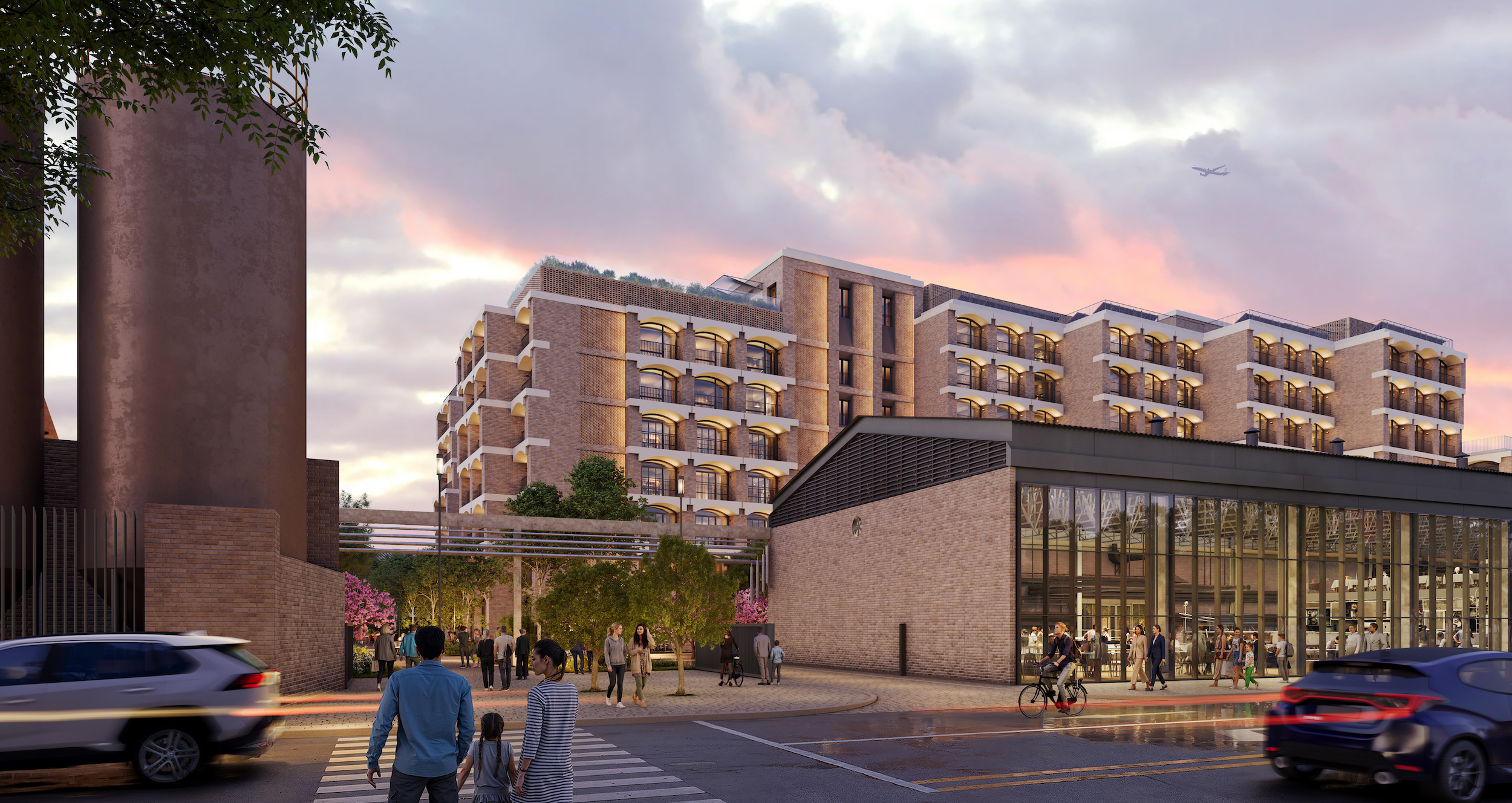
Photorealistic rendering of the FIX development. Image credits: DIMAND
Prices are already moving. In 2025, apartment prices in Thessaloniki rose 9.6%, ahead of Athens at 6.2%, according to the Bank of Greece. The city’s western gateway is following a clear upward trajectory, and the gap between its emerging districts and the established eastern waterfront is where the opportunity lies.
Lisbon’s Marvila reached a comparable turning point in 2017, while Rotterdam’s Katendrecht did so in 2013. Both were former industrial districts bordering prime waterfront locations, entering a new phase just as the first wave of investors and buyers began to recognise their potential.
Thessaloniki’s next chapter is taking shape in the west.