Area Guides:
Thessaloniki
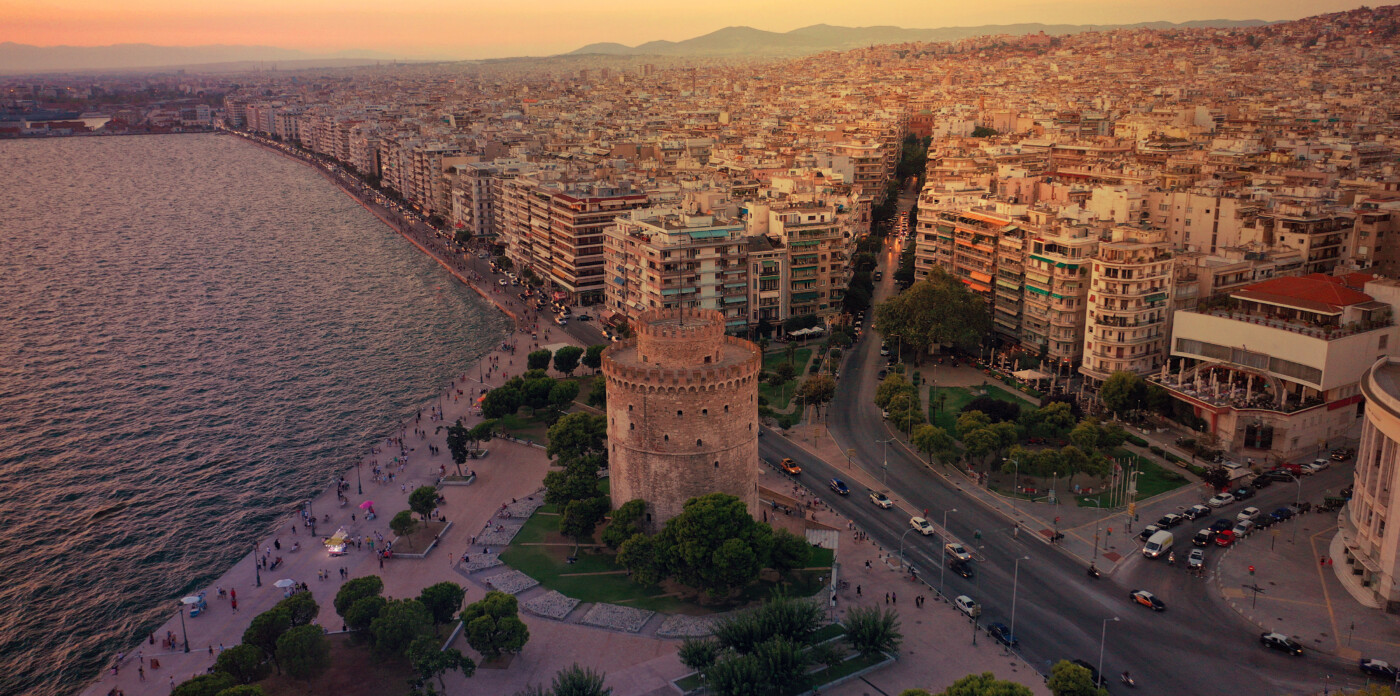
Walk down Aristotelous Square towards the sea and much of Thessaloniki comes into view. Café tables spill beneath the arcades, the city opens onto the Thermaic Gulf, and the waterfront stretches east past the White Tower and towards the gardens of Nea Paralia. On clear days, Mount Olympus appears across the water.
Turn inland and centuries of history remain an ever-present part of the city. Byzantine churches sit between apartment buildings and busy shopping streets. The Roman Agora is embedded in the centre, the Rotunda rises above the university district, and the narrow streets of Ano Poli climb towards the old city walls offering views over the rooftops below.
Thessaloniki is Greece’s second largest city and the commercial, cultural, and educational centre of Northern Greece. Its universities, port, international airport, hospitals, and established business community support a permanent population of 1.1 million people, giving the city a rhythm that endures throughout the year.
Today, new infrastructure and major urban developments are adding to a city that has always had an imposing identity of its own.
Lifestyle & Character
Thessaloniki is a city experienced through its neighbourhoods.
The centre is compact and highly walkable with Tsimiski and Mitropoleos forming its principal shopping streets. Aristotelous opens directly onto the sea and the areas around Agia Sofia, the Roman Agora, and the waterfront are filled with cafés, restaurants, and local shops.
Food occupies a particularly important place in daily life. Mornings begin around Modiano and Kapani, where produce, spices, fish, and traditional food shops fill the markets. Restaurants range from long established dining rooms to a younger generation of chefs drawing on the produce and culinary traditions of Macedonia. Evenings extend naturally into the streets around the centre and the port.
The waterfront gives Thessaloniki much of its visual identity. For approximately five kilometres, the promenade runs between the port and the Concert Hall, passing the White Tower, public gardens, cafés, and open spaces along the gulf. It is used throughout the day by walkers, runners, and cyclists and becomes one of the city’s main meeting points in the early evening.
Further east, Kalamaria has its own established residential character. Aretsou and Nea Krini bring marinas, restaurants, and the sea into everyday neighbourhood life, with the centre now directly connected by the Metro. Panorama rises above Thessaloniki and remains one of the city’s principal addresses for larger residences, with open views over the city and the Thermaic Gulf.
Thessaloniki also sits within the wider landscape of Northern Greece. Halkidiki, the vineyards of Macedonia, Mount Olympus, and the mountain destinations of Northern Greece are all accessible from the city, making weekends beyond the urban centre an established part of life there.
Property Market
Thessaloniki’s prime residential market is highly neighbourhood specific.
Along the waterfront and in the historic centre, demand centres on well positioned apartments, restored residences, and penthouses, particularly those combining architectural character with views, intentional proportions, and modern specifications.
Kalamaria and the eastern districts attract buyers looking for permanent residences close to schools, retail, healthcare, and the city centre. The completion of the Metro extension to Kalamaria has further strengthened connections across eastern Thessaloniki.
Panorama remains the main market for larger private homes and villas, with more space, gardens, and elevated views.
The city is also beginning to see a new category of residential development. Contemporary architecture, energy efficiency, underground parking, private outdoor areas, and professionally managed buildings are becoming increasingly important to buyers at the upper end of the market.
The redevelopment of the former FIX Brewery is one of the most significant examples of this new phase. The Foster + Partners masterplan brings together the restoration of the historic industrial complex with new residences, hospitality, cultural spaces, and public areas, creating a major new destination at the western entrance of the city.
Its significance extends beyond the individual project. Developments of this standard are broadening the type of prime residential property available in Thessaloniki and introducing international design and development standards to a market where supply at this level has historically been limited.
For a detailed analysis of Thessaloniki property market please visit here: Thessaloniki Property Market
Why Thessaloniki
The case for Thessaloniki begins with daily life.
It is possible to live in the centre, walk to restaurants and shops, spend the evening beside the water and reach the airport, the eastern suburbs, or destinations across Northern Greece with relative ease. Culture, universities, healthcare, commerce, and hospitality are part of the permanent city.
For property buyers, this established urban base is increasingly being accompanied by better infrastructure and a higher standard of residential development.
The most interesting homes remain scarce in number, particularly properties that combine a strong location, architectural quality, outdoor space, parking, and contemporary specifications. As Thessaloniki continues to invest in its infrastructure and regenerate important parts of the city, these qualities are set to play an increasingly important role in its prime residential market.
Thessaloniki has always been a city with a strong sense of itself. Its next chapter is now taking shape along its waterfront, through its neighbourhoods, and within a new generation of residential development.