
By
Lee Tokouzis
Director of OperationsTwice a year, Greece Sotheby’s International Realty publishes a full institutional review of the Greek luxury residential market — demand patterns, pricing dynamics, and buyer composition, measured from our proprietary enquiry and transaction records rather than from sentiment or anecdote.
The Mid-Year 2026 edition covers January 1 to June 30, benchmarked against the same window in 2025 and against our five-year baseline. Its central finding is direct: the Greek luxury market has moved past the 2025 moderation, absorbed a genuine geopolitical shock, and is operating meaningfully above trend.
€6.11 billion in demand — nineteen percent above trend
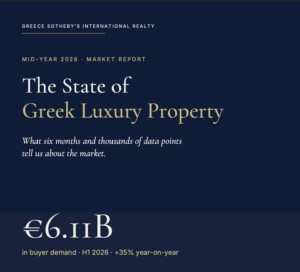
Aggregate buyer demand expressed through our channels reached €6.11 billion in property value during the first half of 2026 — a 35 percent increase year-on-year and nineteen percent above our five-year baseline. The 2025 moderation is now visible for exactly what it was: a pause within a structural expansion, rather than a break in it.
Just as significant as the volume is its quality. The median property value per enquiry moved from €2.30 million in 2025 to €2.95 million in 2026 — a 28 percent upward shift — while the average rose from €5.12 million to €5.89 million, the highest quality profile in our history. Demand has returned larger, more institutional, and more committed than in any prior period we have measured.
A forty-day shock, absorbed
The most consequential event of the half-year was the Iran conflict, and it gave the market a rare natural experiment in resilience. Enquiry rates compressed mildly for exactly twenty days after the outbreak of hostilities in March — while, remarkably, the value of buyer interest kept growing at +36 percent year-on-year even through that window, as average enquiry sizes rose. By mid-April the rebound was decisive: the latter half of April registered growth of nearly fifty percent year-on-year, and June closed the half at +64 percent in value terms.
A luxury market that processes a major geopolitical event in its immediate neighbourhood with a forty-day disruption window, and then exceeds its pre-shock pace, behaves like a mature institutional asset class. That is the response profile of established Northern European markets — and it is now the response profile of Greece.
The British are back — and the buyer pool is broadening
The sharpest movement in buyer composition came from the United Kingdom. UK demand rose 60 percent year-on-year, lifting the British share to 17.4 percent of all enquiries — clearly above its long-term average and the strongest recovery among our five largest buyer origins. The driver is structural: following the abolition of the UK non-dom regime in April 2025, wealth has been relocating out of London, and Greece has emerged as one of the principal beneficiary jurisdictions. Non-domiciled resident buyers — a category with zero presence in our records before 2024 — contributed 29 percent of our 2025 transaction volume, and 53 percent of those buyers are British.
Greek domestic buyers, meanwhile, remain the single largest national segment at 18.8 percent of enquiries — a fact that contradicts the conventional framing of Greek luxury property as a purely export category. And the European pool is widening fast: the Netherlands grew 199 percent year-on-year, Belgium 101 percent, Spain 470 percent, and South Africa — a newcomer to our top origins — 264 percent.
The €5 million-plus tier anchors everything
Properties above €5 million contributed 70 percent of total demand volume in the first half — and that segment expanded 45 percent year-on-year, roughly two-and-a-half times the pace of the sub-€2 million tier. This structural floor, consistent across every period we measure, is the defining characteristic of a mature luxury market: buyers at this price point are materially less rate-sensitive, less macro-sensitive, and less cycle-sensitive than the broader market.
Pricing discipline: the market’s clearest message
Our closed-sales data delivers the most operationally important finding of the report. The median time from publication to signed agreement across our completed sales runs at approximately 238 days — eight months. Forty-one percent of sales close within six months of listing. Thirty-nine percent require more than a year. The difference between the two groups is, overwhelmingly, the initial asking price.
Among listings where we track both 2025 and 2026 asking prices, seventy-two percent of recorded revisions moved downward, with a median reduction of roughly eight percent — across every tier, from sub-€2 million homes to €20 million-plus estates. The lesson for sellers is one we state plainly in the report: a property held at an exploratory price for six or twelve months is remembered by the market as unsold, not as undervalued. The price-at-listing decision is the positioning decision for the lifetime of the marketing cycle.
Athens Riviera, and a country re-rated
Athens Riviera continues to define the structural category of this cycle, with active luxury listings asking a median of approximately €10,000 per square metre and branded off-plan product extending materially above that level. It is the fastest-growing enquiry channel in our measurement framework, and the segment most aligned with the contemporary Mediterranean wealth pool — Gulf family offices, Northern European institutional wealth, and London-based finance professionals.
All of this operates against a transformed institutional backdrop: full sovereign investment grade across all five major rating agencies for the first time since 2010, debt-to-GDP down fifty percentage points from its peak, and a mature non-dom framework attracting wealth-relocation flows. Greek property now competes for institutional global capital on equal terms.
Looking into the second half
The variables we are watching through December: the pace of branded-development delivery on the Athens Riviera, the post-normalisation trajectory of Gulf demand, the continued compounding of the non-dom segment, the ECB rate path — and, above all, pricing discipline, where the market’s capacity to absorb realistically-priced product remains fully intact while its patience for exploratory pricing continues to narrow.
The full report — thirteen sections covering demand, pricing, buyer origins, the conversion funnel, and the macroeconomic context — is available here: The State of the Greek Luxury Property Market H1 2026.