
By
Despina Laou
Corfu carries old money the way its estates carry olive groves: inherited, unhurried, and quietly renewed. Every generation of European wealth has passed through this island, and a striking number of them decided to stay.
That devotion has an institutional root. The British administered the island as a protectorate from 1815 to 1864 and left behind Greece’s first university, a rebuilt water system, a taste for cricket — eleven of Greece’s fifteen cricket clubs remain Corfiot — and a civic culture that still feels legible to the English visitor. Corfu Town added its own flourishes: seventeen philharmonic societies rehearse in its alleys, and nearly every local child grows up reading music.
The guest book reads like a century of European history. Empress Elisabeth of Austria — Sisi — built the Achilleion in the 1890s as her private retreat. Prince Philip was born at Mon Repos in 1921. The Durrell family made the island a literary destination in the 1930s; Gerald’s nature writing and Lawrence’s prose fixed Corfu in the British imagination so firmly that Corfu Town’s central garden now bears the family’s name. In the post-war decades the Rothschild family built their celebrated summer house on the north-east coast with the painter Niko Ghika, and the harbours below have moored the yachts of the Agnellis, the Onassis circle and their successors ever since. Hannah Rothschild, whose childhood summers were spent on the island, described its pull to The Telegraph as “a combination of beautiful landscape, a temperate climate and incredibly charming people.”

Two centuries of such guests shaped the island’s defining trait: discretion. The dress code amounts to linen and flat shoes for the cobbles, the restaurants seat shipping families beside farming families, and the most valuable addresses sit behind cypress and old olive, visible only to those invited. The international press now calls this stealth wealth; the island perfected it generations ago.
Spyros Analytis, our Head of Ionian Sales, was born and raised on the island and has worked in real estate since 1995.
“Corfu keeps its wealth in the family album,” he says. “Discretion here is two hundred years old, and our buyers recognise it the moment they land.”
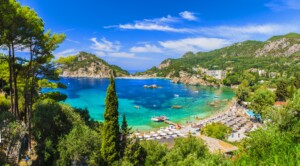
Geography reinforces the temperament. Mountains make Corfu the greenest of the major Greek islands, the Ionian stays calm and warm into October, and the north-east coast — the stretch the British press has long called Kensington-on-Sea — faces the Albanian mountains across a channel of still, deep water. The landscape composes itself, and the houses need only sit within it.
The same temperament shapes today’s market. British buyers lead it: figures as of Mid-Year 2026 Report show the value of UK demand for Greek luxury property rising 60% year-on-year, with UK nationals accounting for 53% of recorded non-dom purchases between 2024 and the first half of 2026 — and the Ionian Islands, led by Corfu, are where lifestyle demand concentrates. What these buyers seek is specific: Venetian estates with provenance, front-line villas on the north-east coast, and land with mature olive groves — assets defined by scarcity, since protected zones and fragmented old ownership keep genuinely prime supply thin. Patience is structure in this market: the right house appears rarely, and it changes hands quietly, often between families who have known each other for a generation.
“The finest houses on Corfu change hands once in a generation. My work is knowing which families hold them — and being trusted by both sides when the moment comes. That trust is built over decades, and it is the only currency that opens these doors.”
— Spyros Analytis, Head of Ionian Sales
That scarcity is the foundation of value here, and it is measurable. The full picture — prime and trophy price bands, micro-markets from Kassiopi to the west-coast bays, buyer profile and scarcity drivers — is set out in our Corfu briefing on the Intelligence Hub, and the current book of available residences is at Corfu properties.