
By
Odysseas Mouselimis
THESSALONIKI has stood at the crossroads of commerce for twenty-three centuries. Founded in 315 BC on the bay where the roads of the Balkans meet the sea, it carried Rome’s Via Egnatia through its heart and ranked second only to Constantinople in Byzantium. For the Balkans, it was, and remains, the one open door to the Mediterranean.
The city has reinvented its waterfront before. In 1869 the medieval sea walls came down and the quay rose in their place, with its grand hotels and shipping houses; by 1888 the railway to Vienna had made the port so busy that visitors remarked on the one day it fell quiet, Saturday, when its Sephardic stevedores kept the Sabbath.
Today a new wave of iconic projects is giving the city what its history deserves: the Metro, the Flyover, the extension of Pier 6 and, at the western gateway, the historic FIX brewery reborn under the signature of Foster + Partners. In this, Thessaloniki follows the path traced by Europe’s great port cities since the 1980s: former industrial waterfronts reopening to public life, shaped by a shared vision for urban renewal and sustained by private investment.Thessaloniki is undergoing a city-wide transformation. A driverless metro, Greece’s largest elevated road bridge, an expanding port and the redesign of Aristotelous Square are reshaping its infrastructure and public realm. At the same time, new cultural institutions are strengthening its international profile.
Together, these developments signal a new chapter for the city, bringing together the key ingredients of Europe’s landmark waterfront regenerations: modern infrastructure, cultural investment, architectural ambition and a closer connection between the city and its port.
The western gateway is where these forces converge. As land for new development grows scarce in central and eastern Thessaloniki, the west offers the space and relative value to carry the city’s next phase of growth. Recent assessments rank the western districts as having the strongest potential for value appreciation across metropolitan Thessaloniki over the next five years.
“From the western gateway to the eastern shore, Thessaloniki is renewing itself in every direction at once.”
Public investment: connecting the western gateway to the rest of the city
The metro reaches the gateway. Thessaloniki’s driverless metro opened in November 2024. In August 2026, the Kalamaria extension added five stations, bringing the network to 18 stations over 14.4 km. Two of them, New Railway Station and Dimokratias, sit right at the western gateway. A north-western extension to Ampelokipoi, Menemeni, Evosmos, Kordelio, Neapoli, Stavroupoli and Efkarpia is planned for completion in 2035.

Thessaloniki metro. Image credits: thessmetro.gr
The Flyover, a faster city. The Flyover upgrades 13km of Thessaloniki’s ring road around a 4-kilometre elevated bridge, the largest ever built in Greece. Delivered as a public-private partnership by AVAX and Metlen, it will double the road’s capacity to 10,000 vehicles an hour and link Efkarpia with Kalamaria, cutting journey times across the city. Completion is scheduled for spring 2027.
Aristotelous Square, the city’s heart renewed. The square and its historic axis to the sea are being redesigned through a public investment of around €26.3 million. The axis already commands some of the city’s highest rents and sale prices, and according to local media, market professionals expect the redesign to lift them further.

Photorealistic rendering of the Aristotelous Square regeneration project. Image credits: Municipality of Thessaloniki
The Holocaust Museum, a place of remembrance. Beside the Old Railway Station, the Holocaust Museum of Greece will become a major institution for remembrance, education and the history of Jewish life in Thessaloniki. The €40 million museum, designed by Efrat-Kowalsky Architects and Heide & von Beckerath with Makridis Associates, is funded by the Greek State, Germany, the Stavros Niarchos Foundation and private donors including Albert Bourla. It is scheduled to open in 2028.
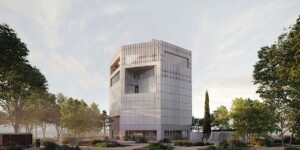
Architectural rendering of the Holocaust Museum of Greece. Image credits: Stavros Niarchos Foundation
A railway for the western suburbs. In May 2026, the Region of Central Macedonia announced plans for a Western Suburban Railway, linking Sindos to the New Railway Station through seven stops, with branches to the port, the Old Railway Station and the Macedonia intercity bus station.
Former military land, new public value. The 672-stremma former Gonou army camp is planned as a logistics and free-trade zone linking the port, the railway and the Sindos industrial area. Nearby, the Pavlou Mela Metropolitan Park opens another former military site to the public.
A port built for bigger ships. In November 2025, Thessaloniki Port Authority signed a €195.6 million contract to expand Pier 6. Over 40 months, the project will more than double annual container capacity, from 650,000 to 1.5 million TEU. Cruise calls rose from 17 in 2021 to 68 in 2023, and the port now serves as a home port.

The port of Thessaloniki. Image credits: ThPA
Private investment: a new residential, cultural and business district
FIX, a brand-new smart city within Thessaloniki. DIMAND is transforming the 25,000 sq.m. former brewery into 68,691 sq.m. of development, masterplanned by Foster + Partners. It brings together 95 residences in a new nine-storey building, the 184-room Hilton Thessaloniki opening in 2029, new homes for the MOMus Costakis Collection and the Thessaloniki State Symphony Orchestra, and dining, wellness, retail and public gardens. The investment is valued at approximately €200 million.
HUB 26, a benchmark for business. Directly opposite FIX, HUB 26 opened in 2024 as Northern Greece’s first large-scale sustainable business park. Developed by DIMAND with PRODEA Investments, the LEED Gold complex spans 31,000 sq.m. across four buildings. Its Black Sea Trade and Development Bank building earned LEED Platinum in December 2025, the first outside Attica.

HUB 26, Western Gateway, Thessaloniki. Image credits: DIMAND
Five-star hospitality. The MET and Porto Palace already anchor 26is Oktovriou. The arrival of Hilton Thessaloniki in 2029 will raise the district’s international profile further.
The West as Thessaloniki’s next growth epicenter
Thessaloniki’s next chapter is being written mainly in the west. With the centre and eastern districts largely built out, the western districts hold the land and the scope for the city’s next phase of growth and recent market assessments rank them first in the metropolitan area for price appreciation over the next five years.
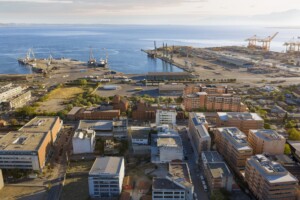
Photorealistic rendering of the FIX development. Image credits: DIMAND
The shift is already visible. At the western gateway, the FIX development forms a new standard for the entire city’s residential market. Around it, the revamped district brings together the same elements behind Europe’s most celebrated waterfront regenerations: public infrastructure, cultural institutions, ambitious architecture and a renewed relationship between the city and its port. It is the same formula that remade Hamburg, Lisbon and Rotterdam and it seems that Thessaloniki is next.